


.png)

What's in our Honey?
- Daunelle Wulstein

- Mar 25
- 3 min read
Updated: Apr 16

We Had Our Honey Tested — Here's What We Found!
We've always believed our bees are doing something truly special in our lavender here in Northern Nevada. But now we have science to back it up.
We recently submitted two samples of our honey to the Penn State Honey and Pollen Diagnostic Lab — part of the university's Center for Pollinator Research — for DNA pollen analysis. The results not only confirmed what our bees are up to, they told a beautiful story about our land and the season.
What Is Pollen DNA Testing?
When bees collect nectar to make honey, they also pick up pollen from the flowers they visit. That pollen leaves behind a kind of botanical fingerprint in the honey. Penn State's lab uses DNA analysis to identify exactly which plants contributed to each batch — giving us a rare, scientific window into where our bees have been foraging.
What We Tested
We submitted two samples of honey harvested at different points in the season:
August Harvest — collected August 29, 2025
October Harvest — collected October 25, 2025
The Results: A Snapshot of Our Land in Every Jar
Across both samples, lavender was the single most dominant plant — coming in at 28% overall. That's no surprise given our 700+ plants on the home property. But what really delighted us was everything else our bees found.

August Honey told the story of high summer on our farm — rich in lavender (33%), with notes of black-eyed susan, yarrow, clover, and coneflower. These are exactly the pollinator-friendly plants we've worked hard to cultivate.
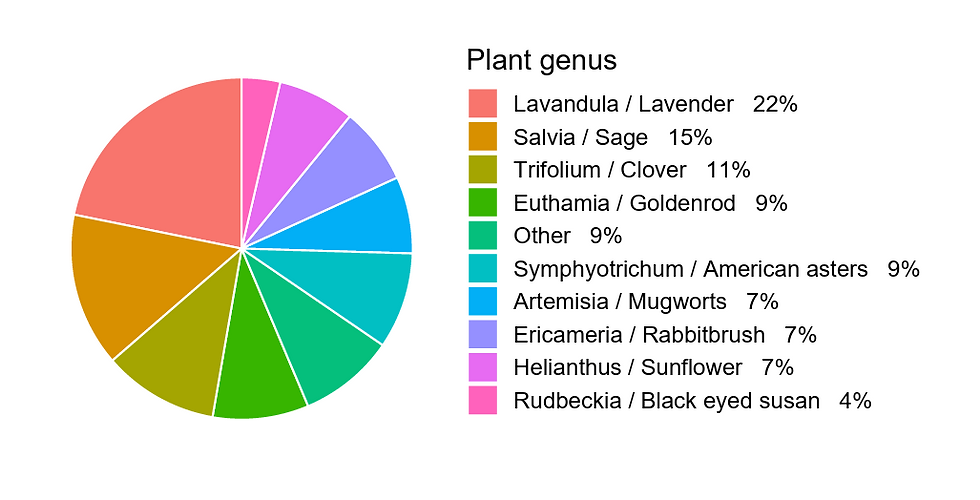
October Honey shifted beautifully with the season — still lavender-forward (22%), but now layered with sage, clover, goldenrod, American asters, rabbitbrush, and sunflower. This is the Nevada high desert in autumn, captured in a jar. This honey might crystallize quicker than our other honeys because it had significant amounts of goldenrod (9%), clover (11%), and alfalfa in the mix — which likely explains faster crystallization in this batch. (See our blog on crystallization for more information!)
Other plants found across our samples include yarrow, sweet clover, alfalfa, mullein, rose, stone fruit blossoms, cosmos, fleabane, and even hydrangea — a rich tapestry of forage that speaks to the biodiversity we're nurturing here.
Why This Matters to Us
When we committed to creating a pollinator-friendly property, we made choices — pulling back on sprays, planting intentionally, letting the "weeds" that bees love grow alongside our lavender. This report is a confirmation that those choices are working. Our bees are thriving on a diverse, healthy landscape, and that comes through in every drop of honey they produce.
This is truly single-origin, small-batch, hyper-local honey — and now we have the science to prove it. Once our bigger field is in bloom, we will be adding bees there. I'm sure we'll have an even higher percentage of lavender in that honey!

Want to Try It?
Our honey is available here on our property, at Sierra Chef in Genoa, Nevada, and at Darling Dutch Bakery in Washoe Valley, Nevada. Whether you choose our summer or autumn harvest, you're tasting the flowers of the Sierra Nevada foothills — lavender, sage, goldenrod, and so much more — just as our bees found them.
Come visit us this summer and see the blooms AND the bees for yourself!


Comments